You already have the customers. Stop losing the orders.
NeighBuy is the software a home food business runs on. Keep selling to your neighbours
exactly the way you do now — and stop losing the orders, the hours and the profit that
WhatsApp costs you.
Built for resident sellers, their neighbours and the communities they live in. Nothing to
install for the people buying from you.
WhatsApp was never meant to run a business. It is very good at conversations.
So keep it for those. What it cannot do is hold an order still — and the cost of that is
paid in hours, measured here against a hundred orders a day.
50 minutes a day
Typing orders back out of a chat window. About thirty seconds each, a hundred times, every
day, on top of the cooking.
17 minutes standing still
Telling thirty people their food is ready, one message at a time — open WhatsApp, find
her, type, come back. Most people send a few and give up.
One order today
Menu posted in the group
She replies, or DMs
You write it in the book
UPI screenshot arrives
“Is it ready?”
Totalled up later, maybe
One order on NeighBuy
Discover
Order
Cook
Ready
Collected
Nothing in the top row is difficult. It is six different places, and no two of them know about each other — so the counting, the chasing and the remembering are all yours.
See how it works
One order, from her tapping a link to the money in your hand
Step through it. The statuses, the pickup code and the payment band are the real ones from
the product.
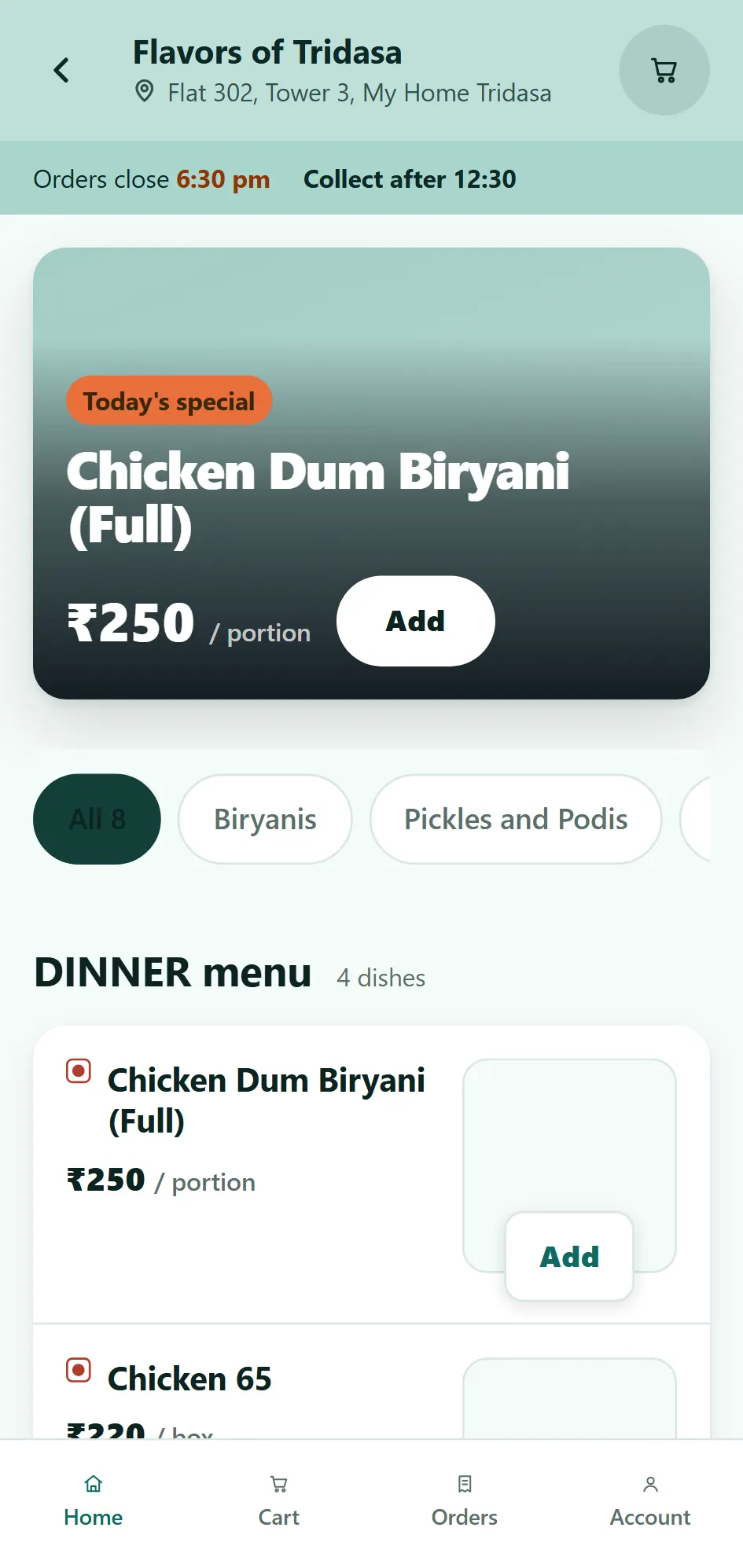
Flavors of Tridasa
Chicken Dum Biryani (Full)2 portions · ₹500
Pickup code4417Collect after 12:30 · Tower 3
Place order
Today’s ordersDinner · 12 August
Priya SharmaTower 2 · Flat 0704
2 portions · Chicken Dum Biryani (Full)
New₹500
Unpaid · collect at the door
Step 1 of 6
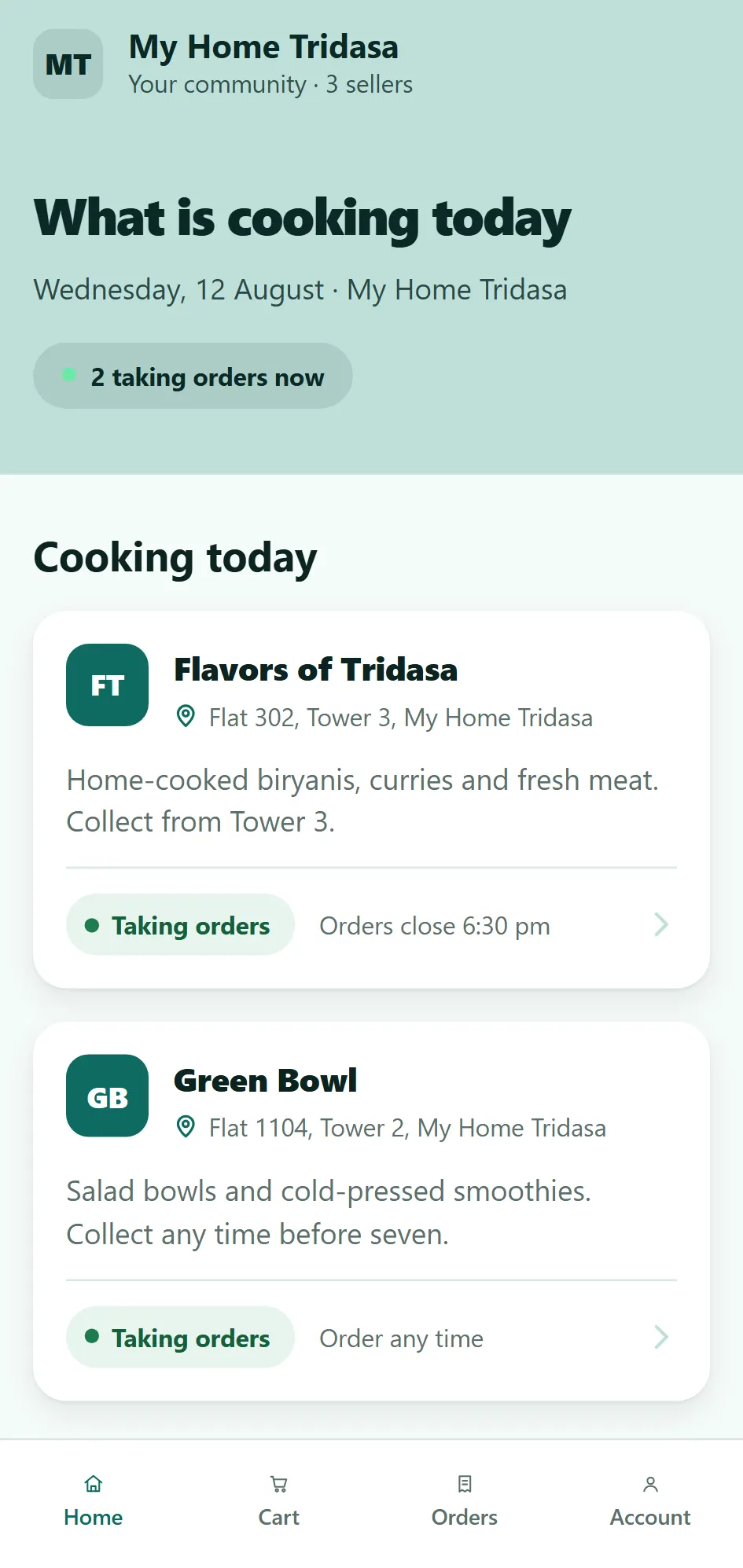
Priya taps the link in your group
No app, no account, no password. She has ordered from you before, so her flat is already known and she is not asked for it again.
Two portions, ₹500, collect after 12:30.
Step 2 of 6
It lands in today’s orders
Counted against your quantity the moment she ordered — so nobody else can buy a portion that is already gone. You confirm it, or it confirms itself if you took it yourself.
Your stock came down by two. The database decided, not a check that ran a moment earlier.
Step 3 of 6
Her order is on the cooking list
Not as a line to read — as a number added into the total. Two of hers plus everybody else’s, with combos broken into their parts.
One action moves the whole service to preparing. You do not start “order 0043”.
Step 4 of 6
Everybody is told at once
One tap moves the whole service to ready and opens your own WhatsApp with the message already written. Thirty separate messages is about seventeen minutes standing still.
The group message carries no names, no order numbers and no amounts.
Step 5 of 6
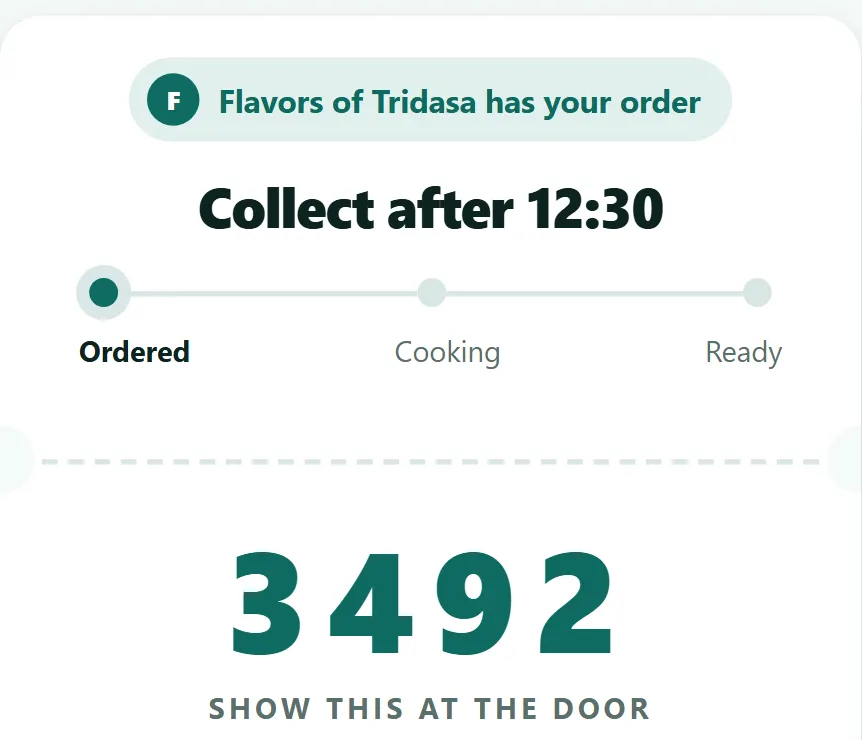
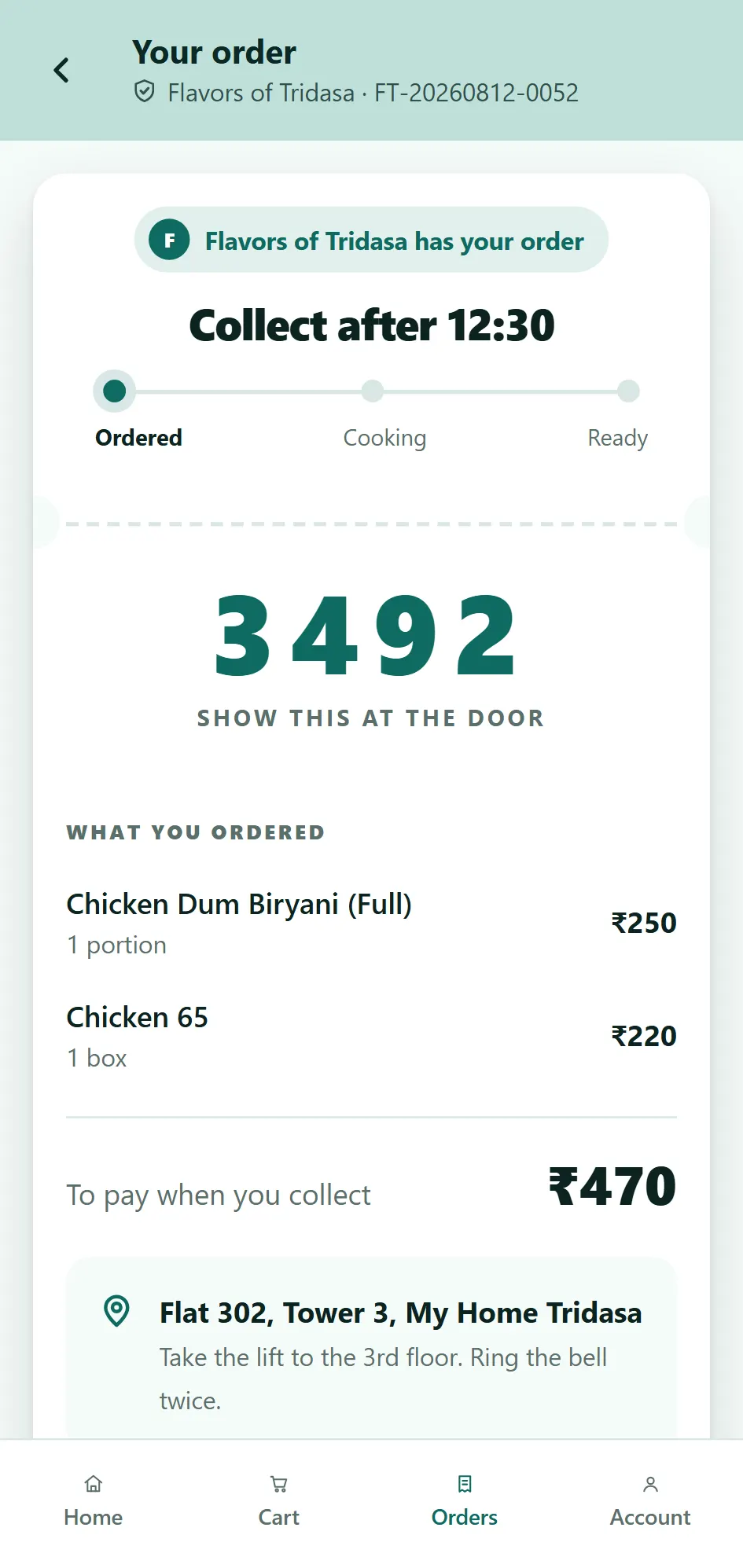
Four digits at the door
She reads out her code. One result, rendered large, with a paid-or-not band you cannot miss. About ten seconds, standing up, one hand.
Undo is available for thirty seconds afterwards, because hands slip.
Step 6 of 6
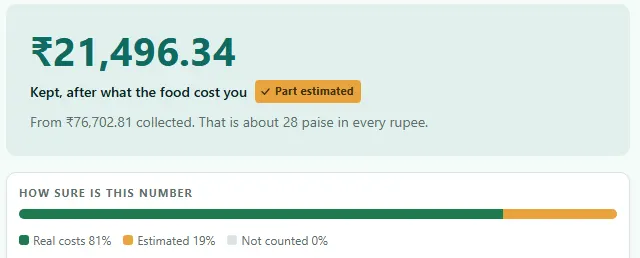
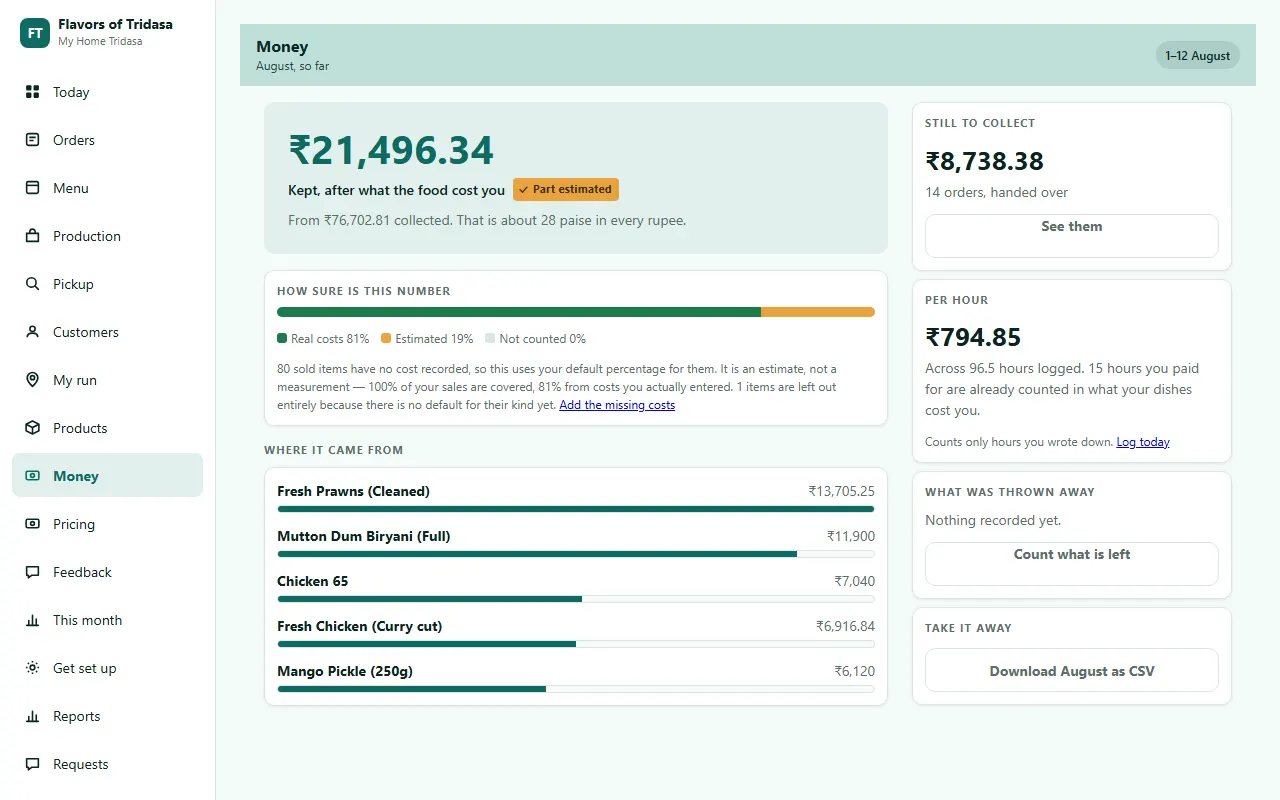
And what it left you
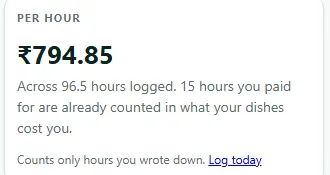
She paid you directly by UPI. Not turnover — what is left after the chicken, the gas and the boxes, and what that came to for every hour you wrote down.
The money never passed through us. There was nowhere for it to sit.
Better for the person buying, the person cooking, and the building
It runs the day, not just records it
Cook from one list instead of counting messages. Hand an order over in ten seconds. Tell thirty people their food is ready with one tap, not thirty.
Combos are exploded into what you actually cook: 20 veg meals and 5 standalone dals is 25 dals on the list.
It tells you what you actually earn
Not turnover. What is left after the chicken, the gas, the boxes and the petrol — and what that comes to for every hour you worked.
And it says how sure it is. A month costed from real numbers reads differently from one filled in with an estimate, and the screen shows which.
Nothing about your business becomes ours
Your WhatsApp number stays yours. Your customers stay yours. Money goes straight from your neighbour to you and never passes through us.
Export every order, customer and product to a spreadsheet whenever you like, including on the day you leave.
The number nobody works out
Six lakh a month, and eighty rupees an hour
Turnover feels like success. Profit divided by the hours you actually worked is the number
that says whether the business is worth your life — and no other tool for this trade will
tell you.
It also tells you how sure it is. Dishes with no cost recorded are left out of the money
rather than counted as free, because a missing cost read as zero shows a hundred per cent
margin, which is the most flattering possible wrong answer.
The number no other tool for this trade will tell her
What was left after the food cost, and what that came to per hour.
Your neighbour does not install anything
She taps the link in the group and she is looking at today’s food. No app, no account, no
password — and that is not a launch compromise, it is a rule we hold ourselves to.
Every one of these is checked automatically, on every change, forever.
30 secondsto put a repeat order in for someone you know, on a phone. Held as a real time budget in an automated test, not as an aspiration.
Exactly 5orders succeed when twenty people go for the last five portions at once. Never four, never six. Checked against a real database, ten times over.
₹0per WhatsApp message. It opens your own WhatsApp with the words already written, so there is no per-message bill and your number does not change.
Where we actually are. Live since August 2026, in one community, with three sellers. That is the whole of it, and we would rather say so than invent a number.
We would rather tell you that than put up logos and a testimonial we have not earned yet.
Everything on this site is a screenshot of something that works today — the parts that are
still being built are labelled as such and have no picture.
Cooking for your neighbours already?
Tell us what you sell and where. We will reply within a working day, and we set the whole
thing up sitting with you — your products, your prices, your customer list.